Lead Flashing & Leadwork Basingstoke
Lead flashing and leadwork repairs that help protect your roof from persistent water ingress.
Lead Flashing & Leadwork for Basingstoke Properties
Lead flashing and leadwork are important parts of many roofing systems because they help seal joints where different materials meet. When these details age, split or lift, water can find a route into the roof structure, so a careful assessment is usually the first step before any repair is specified.
This service is relevant when flashing around vulnerable roof junctions no longer looks sound or performs as intended. The aim is to restore a dependable weatherproof detail rather than simply cover a visible defect.
A sensible approach starts with identifying the exact point of failure and considering whether the issue is localised or part of a wider roofing problem. That helps avoid unnecessary work and supports a repair plan that matches the condition found.
Where leadwork has been repaired before, the next decision is whether the existing detail can still be renewed effectively. If the surrounding materials are also deteriorating, a broader scope may be more practical than treating the lead in isolation.
Leadwork is assessed alongside the other details covered by our roofers covering Basingstoke.
Leadwork and Flashing Topics at a Glance
- Roof survey and visible-condition check
- Clear explanation of the likely cause
- Appropriate material and access considerations
- Written quotation for the proposed scope
How We Assess Lead Flashing
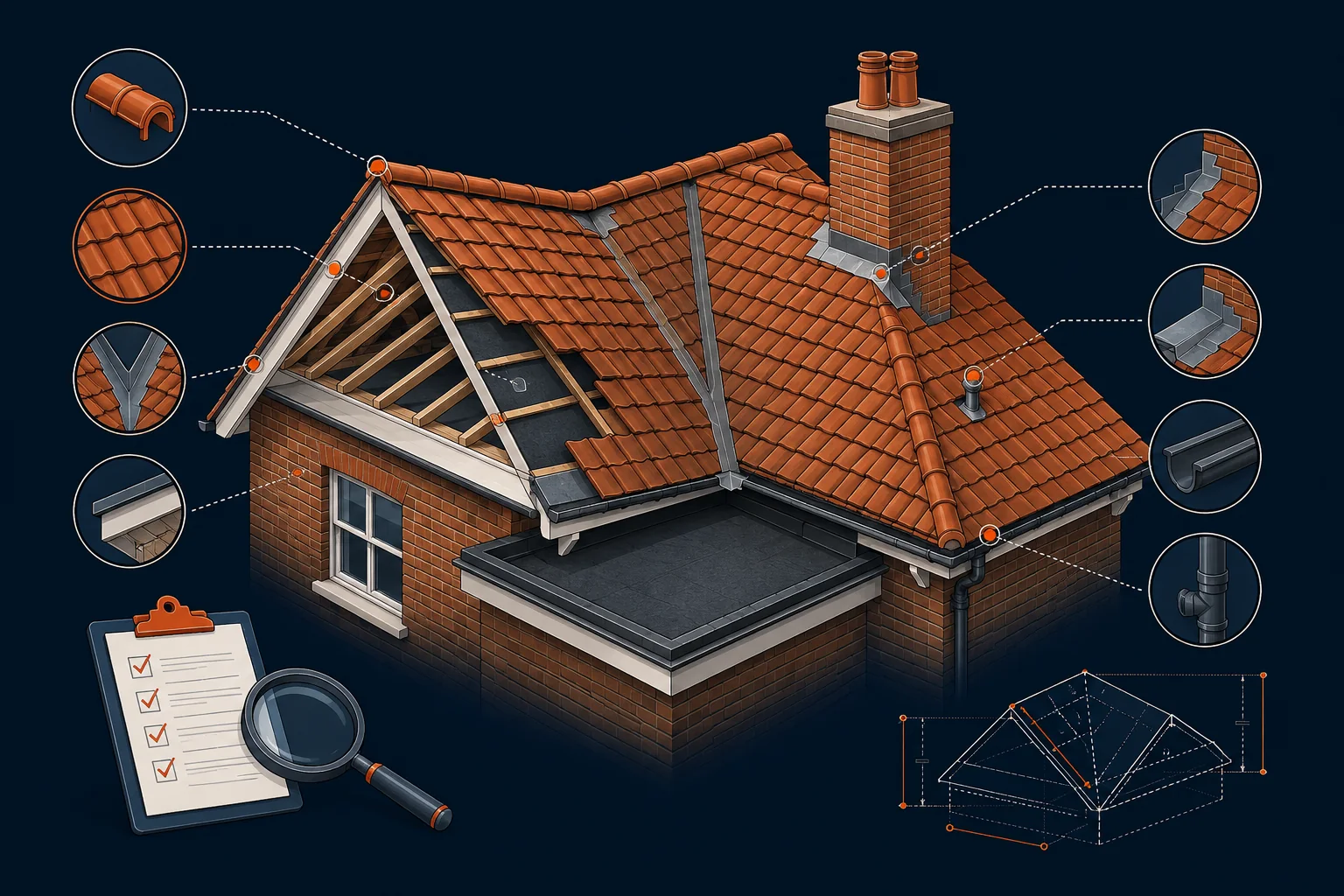
Before repair or replacement is specified, the leadwork should be checked for cracking, lifting, poor joints and signs that water has been tracking behind the flashing. It is also important to look at the adjoining roof surfaces, because nearby defects can make an apparently local issue harder to solve.
A good assessment considers whether the lead itself is the main problem or whether movement in the roof structure, mortar joints or surrounding coverings has contributed to failure. That distinction helps determine the most suitable repair method and avoids repeating the same issue.
The condition of the roof junction, the extent of deterioration and the practicality of carrying out durable work all influence the recommended solution. Careful inspection supports a clearer recommendation and a more reliable written scope.
Inspect before specifying the work
Inspecting before specifying work helps ensure the right part of the roof is addressed, especially where several details meet at one junction. Without that step, it is easy to miss the cause of the leak and treat only the symptom.
A close inspection should check the lead profile, fixings, abutments and any surrounding bedding or pointing that may be affecting performance. That makes it easier to decide whether the detail can be repaired cleanly or whether a replacement section is more appropriate.
It is also useful to compare the condition of the lead against the condition of the adjacent tiles, slates or masonry. If nearby materials are failing, the flashing may be working harder than it should and a wider repair may be needed.
Where access is awkward or the junction is heavily weathered, the inspection should take account of how the work can be completed safely and to a proper standard. A practical recommendation is usually better than an assumption based on appearance alone.
The outcome of inspection should be a clear view of what is defective, what remains serviceable and what must be included to complete the job properly. That gives the customer a more dependable basis for deciding on the next step.
A careful inspection also helps distinguish between urgent repairs and work that can be planned as part of broader roof maintenance. In both cases, the aim is to specify only what is needed and avoid guesswork.
What guides the quotation
Quotation details should be guided by the findings on site rather than by a standard assumption about the repair. The extent of deterioration, the quantity of lead affected and the amount of preparation required all influence the scope.
A written quotation is most useful when it explains what is being repaired or replaced, what adjacent work is included and any limits identified during inspection. That makes the proposed work easier to understand and compare.
Assessment focus
- Inspect laps and fixings
- Allow for lead movement
- Check the complete junction
Written scope
- Visible condition
- Safe access
- Material specification
- Relevant exclusions
Lead Flashing Repairs and Roof Leadwork
Lead flashing repairs and roof leadwork can range from targeted local repairs to fuller replacement of worn sections. The right response depends on the condition found, because some details can be made sound again while others have reached the point where renewal is the better option.
A suitable scope should reflect both the visible defect and the cause behind it. If the lead has failed because of movement, poor detailing or deterioration around the junction, the repair may need to address more than the lead alone.
Where only a small area is affected, a focused repair may be enough to restore weather protection. That can be a practical option when the surrounding roof materials remain stable and the lead is still fundamentally serviceable.
If the issue is more widespread, a repair limited to the visible split or gap may not last. In that situation, replacement of a larger section can provide a more dependable result.
The best scope is the one that matches the actual defect, not the easiest one to describe. That is why assessment matters so much before any work is agreed.
Customers are usually better served by a recommendation that explains the reason for the chosen method. A clear explanation helps set realistic expectations about durability and the extent of the repair.
- The lead detail, laps and surrounding roof junction are assessed together.
- Limited splits may allow a focused repair where the remaining lead is still sound.
- Widespread fatigue or unsuitable detailing may make replacement the more dependable option.
What Lead Flashing Does
Lead flashing helps form a weatherproof transition where the roof meets another surface, such as a wall or chimney. Its job is to reduce the chance of water entering at these vulnerable joints.
Because these junctions move and weather differently from the main roof surface, flashing has to be detailed carefully. If it is not properly formed or maintained, the protective seal can weaken over time.
A well-made lead detail is meant to work quietly in the background, without drawing attention to itself. When it starts to fail, the first signs are often linked to dampness rather than to the lead alone.
That is why visible staining, missing mortar at the junction or signs of movement around the area should not be ignored. They can indicate that the flashing is no longer doing its job effectively.
Lead is valued because it can be shaped to suit complicated roof details, but that flexibility does not remove the need for good installation and maintenance. The surrounding materials still need to support it properly.
When the lead is installed in a way that allows for movement and sheds water cleanly, it is more likely to remain serviceable. Poor detailing, by contrast, can shorten its working life significantly.
- Abutment flashing where a roof slope meets a wall
- Soakers and cover flashing beneath individual tiles or slates
- Aprons and transition pieces around changes in roof level
Signs Leadwork Has Failed
Signs that leadwork has failed often include internal damp patches, external staining or visible gaps at the junction. These symptoms suggest that water may be getting past the protective detail.
In some cases the lead may look intact at a distance but still allow moisture through because a joint has opened or a hidden section has lifted. A proper check is important before deciding on the remedy.
Cracking, splitting and distortion are common signs that the material is under stress or has aged beyond its best condition. The lead may also begin to separate from the surfaces it is meant to protect.
If these signs are present, the surrounding roof detail should be examined as well. The root cause may be movement, poor fixing or wear in adjacent materials rather than the lead alone.
A recurring leak around the same point is often a clue that the flashing needs more than a quick patch. If the problem keeps returning after previous repairs, a fuller investigation is usually worthwhile.
The goal is to identify whether the issue is isolated or part of a failing junction. That distinction helps prevent repeated call-backs and supports a more durable solution.
- Cracks, tears or fatigue lines across the lead sheet
- Lifted edges, loose wedges or open mortar chases
- Water marks associated with an abutment or lead-covered junction
Repair or Replace Lead Flashing?
Whether lead flashing should be repaired or replaced depends on how much sound material remains and what caused the failure. If the damage is local and the rest of the detail is stable, a repair may be enough.
Where deterioration is extensive, replacement is often the better long-term answer. That is especially true if the lead has become badly distorted, repeatedly split or difficult to secure properly.
A patch can sometimes buy time, but it should only be used where the underlying problem is minor and clearly understood. If the patch merely masks a larger defect, the leak may return.
The decision should be based on condition, access and how well the repaired section can be tied into the existing roof detail. A tidy repair is not the same thing as a lasting one.
Replacement is usually considered when repairs would be temporary or when the existing lead is too far gone to hold a reliable fix. In those cases, renewing the affected section gives a clearer path to a durable result.
The surrounding materials and the method of forming the new detail should also be reviewed. A replacement that ignores the cause of failure may not perform as intended for long.
A practical recommendation balances cost, disruption and the likely lifespan of the finished work. That is why a site-specific assessment is more useful than a one-size-fits-all answer.
The most appropriate choice is the one that restores weather protection with the least unnecessary intervention. Sometimes that means a repair; sometimes it means replacement of the affected leadwork section.
- Extent and position of splitting or mechanical damage
- Suitability of the existing lead code, sheet length and laps
- Condition of the wall chase and adjoining roof covering
Leadwork at Chimneys and Valleys
Leadwork at chimneys and valleys often needs careful attention because these are areas where water is concentrated and roof junctions are complex. Good detailing is important for keeping these sections watertight.
If the lead at a chimney or valley has begun to fail, the issue may affect a relatively small area at first but can quickly become more noticeable during heavy rain. Early inspection helps limit further damage.
These junctions are particularly dependent on correct shaping, fixing and overlap. If any part of the arrangement is compromised, water can find a route past the intended barrier.
When repairing these areas, the surrounding materials should be checked alongside the lead itself. That helps make sure the finished detail works as a complete system rather than as an isolated patch.
Because chimneys and valleys are key weathering points, the standard of work there has a strong effect on the performance of the whole roof. Even a small defect can create a disproportionate problem.
A considered repair should therefore address both the visible defect and the way water is moving through the area. That approach supports a more reliable and longer-lasting result.
- Confirm whether the issue sits at a stack, valley or general abutment
- Check how the lead connects with tiles, slates and masonry
- Define the leadwork boundary clearly within the written scope
A Written Scope for Roof Leadwork
Condition
The condition of the leadwork should be judged in context, not just by appearance from the ground. Some defects are obvious, but others only become clear once the junction is examined closely.
A sound recommendation depends on understanding how far the deterioration has progressed and whether the material can still be trusted. That is the basis for deciding between repair and renewal.
Access
Access matters because leadwork is often positioned at awkward roof junctions where safe working and good workmanship both depend on the setup. If access is limited, the method chosen may need to be adapted.
The practical aim is to complete the work safely while still allowing the detail to be formed and fixed correctly. Good access planning helps support a tidy and durable finish.
Specification
Specification should cover what is to be repaired or replaced, how the junction will be made weatherproof and what preparation is needed beforehand. A clear specification reduces uncertainty and helps the job be carried out consistently.
It is also useful for the specification to reflect any limitations found during inspection, such as fragile surrounding materials or the need to extend the repair. That makes the proposed work easier to understand and deliver.
Lead Flashing & Leadwork FAQs
A lead soaker is a small lead-lined piece used to help manage water at roof junctions, usually where a vertical surface meets the roof covering. It forms part of the weathering detail rather than acting as a visible finish on its own.
Soakers need to be installed in the right position and in the right sequence with the surrounding roof covering. If they are damaged or poorly fitted, water can bypass the intended path and reach the structure below.
Lead flashing can split because the material has aged, been stressed by movement or been formed in a way that does not allow it to move naturally. Poor support from surrounding materials can also contribute to failure.
Once a split appears, the area should be checked carefully because the visible crack may be only part of the problem. The underlying junction may also need attention if the defect has been developing for some time.
Lead flashing can sometimes be patched if the affected area is small and the rest of the detail is still in good condition. A patch is most sensible when it genuinely restores the weatherproofing without hiding a larger defect.
If the flashing is widely degraded, patching may only delay a more permanent solution. In that case, replacement is usually the more reliable option.
The code of lead refers to the thickness category of the lead being used for a particular roofing application. Different codes are chosen for different situations depending on the demands of the detail.
Using the correct code matters because the material needs to be suitable for the location and the way it will move in service. A specification should therefore match the task rather than relying on a generic choice.
Ask about lead flashing & leadwork
A written quotation for lead flashing and leadwork should follow the inspection findings, because the extent of deterioration determines what can be repaired and what needs renewal. The more clearly the defect is understood, the more accurate the proposed scope can be.
Material choice, access requirements and the amount of surrounding work needed all affect the final quotation. A good written quote should make these influences clear so the customer can see how the solution has been assembled.
If you need lead flashing or leadwork assessed, the next step is usually a careful inspection and a written explanation of the recommended scope. That gives you a clearer basis for deciding whether the answer is a repair, a replacement section or a broader roof detail.
The aim is to provide a practical roofing solution that matches the condition found and supports dependable weather protection. Clear findings and a clear quotation make that process easier to manage.